Introduction
The financial trading landscape in 2026 has been fundamentally transformed by artificial intelligence. What was once the exclusive domain of hedge funds and institutional investors with multi-million dollar budgets is now marketed directly to everyday retail traders through AI-powered trading platforms. The promise is seductive: sophisticated algorithms that analyze markets 24/7, execute trades at optimal moments, and generate consistent returns—all with minimal human intervention.
Two platforms have emerged as significant players in this space: AI Trading Engine, a JVZoo product created by Sean Donahoe launching on September 1, 2026, and AlgosOne, an established AI trading service with a 4.4/5 Trustpilot rating and thousands of active users.
But here’s the critical question every potential investor must ask: Do these platforms actually work, or are they just another iteration of the “get rich quick” schemes that have plagued the trading industry for decades?
AI-powered trading tools can now analyze large amounts of market information, scan multiple charts, identify patterns, summarize research, and help traders make decisions faster. But there is a big difference between an AI tool that helps a trader research the market and a fully automated trading bot that places trades on the user’s behalf.
That distinction is particularly important when evaluating AI Trading Engine.
AI Trading Engine is a new trading-focused system from Sean Donahoe that is being launched through JVZoo in September 2026. The product combines an AI agent environment called Wayland with a trading workflow designed to analyze stocks overnight and produce a concise morning brief with a ranked trade idea and supporting reasoning.
According to the official launch information, the system is designed to run on the user’s own computer and charting account. Most importantly, it does not automatically place trades. The AI performs the research and presents the analysis, while the user remains responsible for deciding whether to take a trade. The accompanying five-day training is also designed around paper trading before real capital is considered.
Table of Contents
→ Get Started With The AI Trading Engine ($47, one-time)
Get Started With The AI Trading Engine – Mega Bundle
What Is AI Trading Engine?
AI Trading Engine is a training and software system created by Sean Donahoe that claims to provide an “overnight research setup” and a five-day class designed to help users build their own AI-powered trading systems. Unlike traditional trading courses that teach manual analysis and discretionary trading, AI Trading Engine focuses on leveraging artificial intelligence to automate the research process.
According to the vendor’s current description, Wayland can perform scheduled tasks, coordinate multiple AI assistants, use shared memory, run workflows, and perform other automated research tasks. The trading workflow is one specific application built on top of that broader AI environment.
The trading component is designed to:
- Scan a defined group of stocks
- Read and analyze charts
- Research potential setups
- Compare opportunities
- Test ideas against historical data
- Rank qualifying trade candidates
- Produce a concise morning report
- Explain the reasoning behind the analysis
- Leave the final trade decision to the user
The vendor currently states that the system can scan 74 stocks, with 19 AI agents involved in the overnight analysis process. It also describes testing ideas against historical data covering 26 years and 100 stocks. These are vendor-provided specifications and should be treated as product claims rather than independently verified performance results.
That distinction is important.
A system can process a large amount of information without necessarily predicting the market correctly.
How Does AI Trading Engine Work?
The basic workflow is easier to understand than some of the marketing language surrounding AI trading.
Step 1: Set Up the System
The product is designed to run on the buyer’s own computer.
The vendor describes the setup as running locally rather than entirely through a remote server. It also states that the system works with the user’s own charting account.
This is different from many cloud-based trading services where users simply log in and allow a remote system to operate.
Step 2: Give the AI Instructions
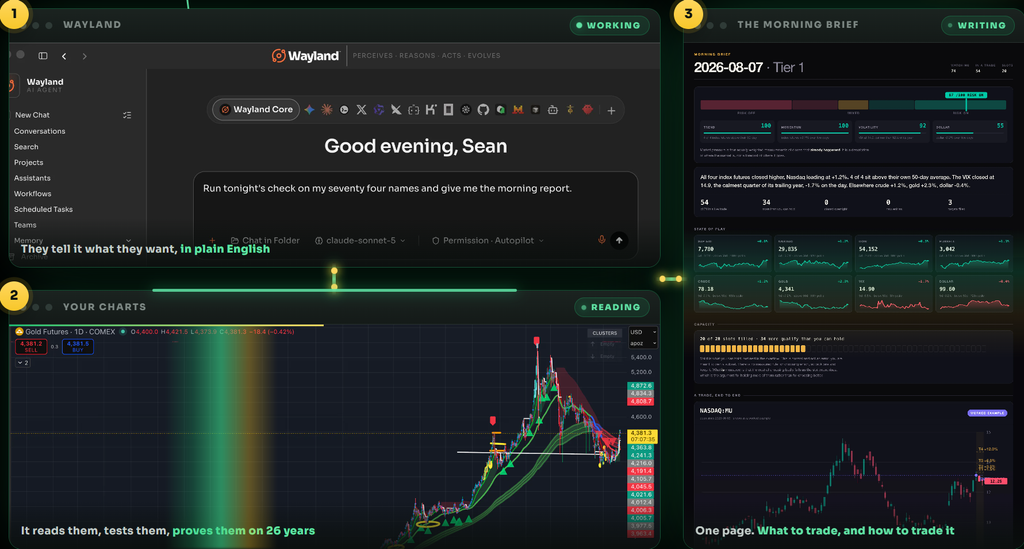
Users can communicate with the system in plain English.
Instead of manually searching dozens of charts, the AI can be instructed to look for specific types of setups or research particular ideas.
The objective is to make market research more accessible to someone who doesn’t want to spend hours manually scanning charts.
Step 3: Overnight Market Analysis
According to the official launch page, the system can run scheduled scans while the user is away from the computer.
The described workflow uses multiple AI agents to review a watchlist and eliminate weaker candidates before producing a more focused result.
This is arguably one of the more interesting parts of the product.
Instead of receiving dozens of unrelated alerts, the intended workflow is to wake up to a concise report.
Step 4: Morning Brief
The system is designed to produce a one-page morning brief.
The report is intended to summarize:
- What opportunity was identified
- Why it qualified
- Relevant chart information
- Potential entry
- Potential stop
- Potential target
- Supporting reasoning
The important word here is potential.
The AI’s output is analysis, not a guaranteed prediction.
Step 5: Human Decision
This is where AI Trading Engine differs significantly from an automated trading bot.
The system does not automatically execute the trade.
According to the official page, the AI researches and draws the relevant levels, then stops. The user decides what to do.
That creates an additional layer of human responsibility.
It also means the product doesn’t remove the need to understand basic trading principles.
What Is Wayland AI?
Wayland appears to be the underlying AI environment that powers the trading workflow.
The vendor describes it as more than a chatbot.
According to the current product information, Wayland includes features such as:
- Scheduled tasks
- Automated workflows
- Shared memory
- AI assistants
- Specialist teams
- Multiple AI models
- Projects/workspaces
- Integrations
- Persistent workflows
The official JV page currently describes 176 workflows, 73 assistants, 26 specialist teams, 2,200+ skills, and 80+ integrations as part of the broader Wayland environment.
These numbers describe the platform’s advertised capabilities, not trading performance.
That distinction is critical.
A large number of AI assistants or workflows does not automatically mean better investment returns.
The real question is whether the specific trading workflow produces useful, understandable, and repeatable analysis.
How we’re doing it
Does AI Trading Engine Actually Trade for You?
No.
This is one of the most important facts to understand.
AI Trading Engine is not being presented as a fully autonomous trading bot.
The official material explicitly says that the system does not touch the user’s account and does not automatically place trades. Instead, it performs the research and gives the user a decision framework.
That can be viewed as a positive from a control perspective.
You aren’t simply handing control of your account to an AI.
But there is also a downside.
Because the system doesn’t execute trades automatically, the user still has to:
- Review the analysis
- Understand the proposed setup
- Decide whether to act
- Place the trade
- Manage the position
- Accept the outcome
In other words:
AI assistance does not remove trading responsibility.
AI Trading Engine and Paper Trading
Another notable feature is the emphasis on paper trading.
The five-day training is described as using TradingView’s practice account so students can work through the system without immediately risking real money.
This is a sensible educational approach.
Paper trading allows a beginner to understand:
- How the AI produces its analysis
- How entries are identified
- How stops and targets are interpreted
- How the workflow operates
- How the user responds to the AI’s recommendations
However, paper trading is not identical to live trading.
Real money introduces emotions that don’t always appear in a simulated environment.
So even if a paper-trading strategy performs well, that does not establish that the same performance will continue with real capital.
What Is Included in the 5-Day Live Training?
The front-end offer currently includes a five-day live masterclass.
According to the official launch schedule, the training runs from Monday, September 7 through Friday, September 11, 2026, at 11 AM ET.
The current curriculum is structured roughly like this:
Day 1 — Setup
The first day focuses on installing and configuring the system.
The objective is to have the AI environment running before the trading workflow begins.
Day 2 — Market Hunt
The second day introduces the market-analysis workflow.
The AI has already run its overnight research, allowing participants to review the results.
Day 3 — Trade
The third day focuses on understanding and acting on the AI’s output within the paper-trading environment.
This is where the educational process moves from research toward execution.
Day 4 — Expansion
The fourth day expands the workflow and introduces additional ways to use the system.
The vendor also describes journaling and grading as part of the process.
Day 5 — Review and Q&A
The final day includes an open Q&A and a review of the week’s process.
This structure is useful because buying software without understanding how to use it can lead to poor results.
The training component may therefore be just as important as the AI software itself.
Full Pricing & Funnel Breakdown
This is the part most reviews gloss over, so here it is in full — sourced from the vendor’s own affiliate/JV materials, which lay out the entire funnel in detail:
| Offer | What it is | Price |
|---|---|---|
| The AI Trading Masterclass (front end) | The five-day live class described above | $47 one-time |
| Inside Edge (order bump) | Sean runs his own AI live in public; ongoing subscription | $29/month, after a 14-day free trial |
| Red Carpet VIP (upsell 1) | The AI setup extended to crypto, extended sessions, permanent recording access | $97 |
| Inner Circle (upsell 2) | Expands the watchlist universe to a stated 100 stocks, plus a “Strategy Library” | $197 |
| The Complete Bundle (webinar-only offer) | Everything above, plus the AI Profit Protocol intensive | $497 (or 3 payments of $197) |
| The AI Profit Protocol (standalone intensive) | Sean’s own S&P 500 (SPX)-based framework, AI-enhanced | $497 |
→ Get Started With The AI Trading Engine ($47, one-time)
Get Started With The AI Trading Engine – Mega Bundle
A few things worth being direct about:
- The advertised $47 is only the entry point. If you go through the full ladder — front end, both upsells, and the intensive — the vendor’s own materials put the total at $838. The all-in bundle at $497 is presented as the better value if you know upfront you want everything.
- The $29/month order bump has a 14-day free trial, meaning it isn’t billed until roughly two weeks after signup — so it’s easy to forget you agreed to a recurring subscription buried in the checkout order bump. If you don’t want it, cancel before the trial ends.
- The vendor’s own affiliate materials state that on a prior, similarly structured launch, the $497 bundle accounted for the majority of total revenue and affiliate commissions, and that most bundle buyers purchased it directly rather than working up through the cheaper tiers — which is useful context if you’re trying to decide between the $47 entry and going straight for the bundle: apparently most repeat buyers of Sean’s launches conclude the bundle is the better deal.
Refund Policy
The sales materials refer to “a real refund window” without stating the exact number of days in the JV/affiliate documentation reviewed for this article. Because refund terms for the front end, the order bump subscription, the upsells, and the $497 bundle can all differ, do not assume a blanket policy — check the specific refund terms shown at checkout for each item before purchasing, and keep any confirmation email in case you need to reference it later.
Marketing Numbers vs. Trading Numbers — An Important Distinction
Because this offer is promoted through an affiliate program with cash prizes for top-selling affiliates, a lot of the numbers that circulate around it are affiliate marketing metrics, not evidence of trading performance. For example, figures like “$21,309 paid to affiliates” or projected “earnings per click” for affiliates describe how well the sales page converts and how much affiliates get paid — they say nothing about whether the underlying trading strategy is actually profitable for the end user. If you see these figures used as “proof” the trading system works, that’s a conflation worth catching: they’re proof the funnel sells, not proof the trades win.
The only genuinely trading-relevant proof points offered are the claimed 26-year, 100-stock backtest and the single cited trade example. Neither a backtest (which can be shaped by which data and rules are chosen) nor a single example is a substitute for a transparent, third-party-verified track record across many trades and multiple market conditions.
How This Compares to a Fully Automated AI Trading Bot
It’s useful to place this offer against a different category of “AI trading” product: fully automated trading bots, such as AlgosOne, a regulated platform (licensed in the Czech Republic) that trades stocks, forex, and crypto on a user’s behalf with no manual execution step, typically charging a percentage commission only on profitable trades. The two categories solve different problems:
- AI Trading Engine (Sean Donahoe): AI does the research and analysis; a human makes the final call and executes every trade, starting on paper. No trading license is required to use it because it never touches your brokerage account directly.
- Fully automated bots (e.g., AlgosOne-style platforms): The software executes trades directly. This removes the manual step but means you’re trusting the algorithm with live execution, and you should specifically verify the platform’s regulatory status, fee structure (spreads, commissions, withdrawal fees), and how it handles losing trades before depositing funds with any such service.
Neither model is inherently superior — the “AI hands you a decision, you execute” model gives you more control and a lower barrier (no funded brokerage account required to learn), while a fully automated bot trades the emotional decision-making out of the loop entirely, for better or worse. If you’re risk-averse or new to trading, the decision-support model paired with mandatory paper trading is the more conservative starting point of the two.
The Case For It
- Genuinely low-risk way to test the concept. The entire five-day class is done in a paper-trading account, so no real capital is required to see whether you like the process.
- Low entry price relative to typical trading education. $47 for five live days with direct access to the instructor is inexpensive next to many trading courses that run into the hundreds or thousands of dollars upfront.
- No forced automation. Because the AI stops short of placing trades, you retain full control and can apply your own judgment before risking money.
- A real, tenured operator, not an anonymous storefront. Sean Donahoe’s decades-long public sales history, while self-reported in its specific figures, is at least a checkable, long-running identity rather than a brand-new persona.
- Wayland has utility beyond trading, according to the vendor’s own description, which may be relevant if you’re weighing the offer partly as a general AI-agent tool.
The Case for Caution
- Six-figure funnel, one purchase. By the time you’ve seen the order bump and both upsells, the checkout experience is a multi-step ladder designed to maximize spend, not a single simple purchase — know your budget ceiling before you start clicking through.
- The recurring order bump is easy to miss. A 14-day free trial on a $29/month subscription means the first charge lands well after the excitement of day one has worn off.
- Heavy reliance on urgency and hype in the marketing. Countdown timers, cart-closes-forever framing, and an affiliate incentive structure (including a $10,000 affiliate prize pool) are all present — none of these are evidence of quality, and they’re worth mentally discounting when reading the sales page.
- No independently audited trading track record. Every performance-related figure in the materials reviewed originates from the vendor. That doesn’t make it false, but it means you should treat win-rate and profitability claims as unverified until you’ve tested the process yourself on paper.
- It’s a brand-new launch of this specific product, even though the vendor himself is long-established, so there isn’t yet a large body of independent, post-purchase user reviews to weigh against the sales copy.
- Refund terms weren’t fully specified in the materials reviewed — confirm them yourself at checkout rather than assuming a standard policy applies across every tier.
AI Trading Engine Pros
1. It Doesn’t Automatically Trade
This is probably the strongest structural advantage.
The AI analyzes the market, but the user remains in control.
That is different from handing an automated bot direct access to your brokerage account.
2. It Explains Its Reasoning
The system is designed to provide reasoning alongside the trade idea.
That makes the output potentially easier to review than a simple “BUY” or “SELL” signal.
3. Paper Trading Comes First
The training environment uses TradingView’s practice account.
That provides an opportunity to learn the workflow without immediately committing real trading capital.
4. Overnight Research Can Save Time
Manual chart scanning can take significant time.
An automated overnight research process could reduce some of that workload.
5. Local Setup
The vendor says the system runs on the user’s own computer and charting account rather than requiring the core engine to operate entirely through a vendor-controlled server.
That may appeal to users who prefer greater control over their setup.
6. Live Training
The five-day live format may be useful for beginners who would otherwise struggle with installation and configuration.
AI Trading Engine Cons
1. No Trading System Can Eliminate Market Risk
This is the biggest limitation.
Markets are unpredictable.
Even sophisticated AI models can produce incorrect conclusions.
Historical data can support a strategy, but it cannot guarantee future performance.
2. AI Can Be Wrong
An AI model is only as useful as:
- Its data
- Its methodology
- Its assumptions
- Its implementation
- Its ability to adapt to changing conditions
A model can identify a setup that looks excellent historically and still fail in a live market.
3. You Still Need to Make the Decision
The product doesn’t automatically execute trades.
That means users must understand what the AI is showing them.
If you don’t understand risk management, position sizing, stop losses, or market volatility, AI output alone doesn’t solve the problem.
4. The Product Is New
This is a particularly important point for this review.
As of August 30, 2026, the official launch is still upcoming.
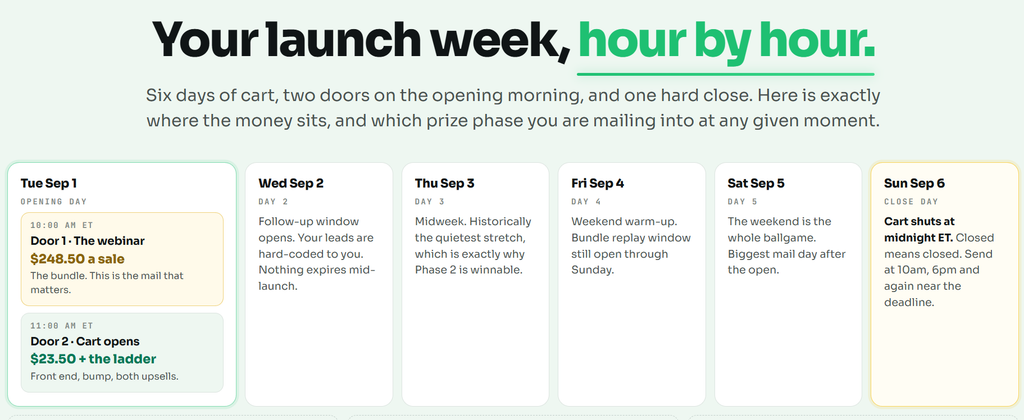
The JV page currently schedules the main cart opening for September 1, 2026.
Therefore, there is not yet a meaningful long-term post-launch customer performance record that can be independently evaluated.
This means nobody should honestly claim that AI Trading Engine has already produced consistent returns for a large number of customers.
5. Additional Costs Can Add Up
The front-end is $47, but the funnel contains several additional offers.
A buyer who accepts multiple upgrades could spend substantially more than the initial price.
Is AI Trading Engine Legit or a Scam?
This is a question many people will search before purchasing.
Based on the information available at the time of this review, there is not enough evidence to label AI Trading Engine a scam.
There is a real product, a named vendor, a structured training program, and a JVZoo marketplace listing. JVZoo currently lists Sean Donahoe as the seller and shows the AI Trading Engine front-end at $47.
The official JV page also provides substantial information about the product structure, training schedule, technology, pricing, and vendor background.
However, “legitimate product” and “profitable trading system” are two different questions.
A product can be real without guaranteeing investment success.
Our assessment:
AI Trading Engine appears to be a legitimate digital product and training program, but its future trading performance cannot yet be independently established.
That is the more accurate conclusion as of August 30, 2026.
Who Is Sean Donahoe?
The vendor behind AI Trading Engine is Sean Donahoe.
According to the official JV page, Donahoe describes himself as having 27 years of experience in online business and trading. The page also states that his products have generated more than $25 million in sales and more than $6.6 million in affiliate commissions, alongside a Top 1% JVZoo vendor designation and 16 Products of the Day.
JVZoo’s current seller profile provides additional marketplace-level information and lists Sean Donahoe as a seller with a long-standing account.
These points can support the vendor’s experience in online product launches.
But they should not be interpreted as proof that AI Trading Engine will produce profitable trades.
Marketing experience and trading performance are separate things.
That distinction is important for maintaining a trustworthy review.
What Should Beginners Know About AI Trading?
Beginners should understand one simple principle:
AI does not remove risk from financial markets.
It can potentially improve:
- Speed
- Data processing
- Research
- Pattern recognition
- Workflow automation
- Consistency
But it cannot guarantee:
- Profits
- Accurate predictions
- Winning trades
- Protection from losses
- Future market direction
Even AI trading providers acknowledge that trading can result in losses. AlgosOne’s beginner guide, for example, explicitly notes that market direction cannot be predicted with absolute certainty and that AI systems can misinterpret their data or rely on unsuitable strategies. AI Trading Engine Review
Is AI Trading Engine Good for Beginners?
Potentially, yes—but with an important qualification.
The five-day live training and paper-trading approach could make the product easier for a beginner to understand than simply downloading an AI tool and being left alone.
However, beginners should not interpret “easy to use” as “easy to make money with.”
Those are completely different things. AI Trading Engine Review
A beginner should understand at least the basics of:
- Stock markets
- Market volatility
- Position sizing
- Stop losses
- Risk/reward
- Trading psychology
- Paper trading
- Portfolio risk
The AI can assist with research, but it cannot take responsibility for your money.
Who Might Benefit From AI Trading Engine?
The product may be interesting for someone who:
- Wants to explore AI-assisted market research
- Already follows stock markets
- Wants to reduce manual chart scanning
- Prefers a human-controlled trading process
- Wants to experiment with AI workflows
- Is willing to learn the system
- Wants to start with paper trading
- Understands that trading involves risk
Who Should Probably Avoid It?
I’d be cautious if you:
- Need guaranteed income
- Cannot afford to lose money
- Want completely passive trading
- Don’t want to learn trading fundamentals
- Expect AI to predict every winning trade
- Are buying because of income screenshots alone
- Believe historical backtesting guarantees future returns
Financial pressure and speculative trading are a particularly bad combination.
If losing the purchase price—or later trading capital—would create financial difficulty, the sensible choice is not to rely on an AI trading product as a solution.
Is AI Trading Engine Worth It?
This depends on what you mean by “worth it.”
If you’re asking:
“Will this guarantee that I make money?”
No.
There is no responsible basis for saying that.
If you’re asking:
“Does the product offer an interesting AI-assisted trading workflow for $47?”
That’s a more reasonable question.
The current front-end includes the AI Trading Engine and five days of live training, along with several stated bonuses.
The $47 price is relatively low compared with many trading education programs.
However, the value ultimately depends on whether you actually use the system.
What I Like About AI Trading Engine
The strongest part of the product is not the word “AI.”
It’s the workflow.
Instead of overwhelming a trader with dozens of indicators and hundreds of alerts, the system aims to narrow the market down to a smaller number of potential opportunities and explain why they were selected.
The second positive is the decision-making boundary.
The AI doesn’t automatically place trades.
That provides a layer of human control that many automated systems don’t emphasize.
The third advantage is the paper-trading component.
Learning before risking capital is a much more sensible approach than jumping directly into live trading.
What Concerns Me?
The biggest concern isn’t necessarily the technology.
It’s expectations.
The AI trading industry is full of marketing language that can make sophisticated technology sound like a guaranteed money machine.
AI Trading Engine should not be evaluated that way.
The product is launching in September 2026, so long-term customer evidence is still developing.
The vendor’s claims about scanning 74 stocks, 19 agents, 26 years of historical data, and other technical capabilities are interesting, but they don’t automatically establish future profitability.
That is why I would judge this product primarily as:
AI-assisted trading research + education
rather than:
guaranteed automated income
AI Trading Engine Rating
Because the product has not yet completed its launch as of the date of this review, I would avoid giving it an inflated performance rating.
Instead, here’s a category-based assessment based on the currently available information:
| Category | Rating |
|---|---|
| Concept | 4.5/5 |
| AI Workflow | 4.3/5 |
| Human Control | 4.6/5 |
| Beginner Training | 4.2/5 |
| Entry Price | 4.4/5 |
| Transparency of Product Structure | 4.0/5 |
| Evidence of Long-Term Results | 2.5/5 |
| Overall | 4.0/5 |
Why only 2.5/5 for long-term evidence?
Because the product is new.
As of August 30, 2026, the main launch hasn’t happened yet.
It would be misleading to pretend that thousands of users have already produced verified long-term results.
This rating can be updated later when meaningful independent evidence becomes available.
Final Verdict: Is AI Trading Engine Worth Trying?
AI Trading Engine is one of the more interesting AI-assisted trading products because it doesn’t appear to be built around the idea of giving a black-box bot complete control over your account.
Instead, its current model is based on:
Research → Analysis → Explanation → Human Decision
The Wayland environment is designed to automate parts of the research process, while the user remains responsible for the actual trading decision. The five-day live training and paper-trading approach also make the product more educational than a simple signal subscription.
The $47 front-end price is relatively accessible, but buyers should remember that additional offers exist, including a recurring $29/month option and higher-priced upgrades.
The biggest reason for caution is the product’s timing.
AI Trading Engine has not yet established a long-term independent performance record as of August 30, 2026.
Therefore, I would not recommend judging it based on promises of income.
Judge it based on the actual technology, training, workflow, usability, and your own risk tolerance.
→ Get Started With The AI Trading Engine ($47, one-time)
Get Started With The AI Trading Engine – Mega Bundle
Frequently Asked Questions
What is AI Trading Engine?
AI Trading Engine is an AI-assisted trading research and education system created by Sean Donahoe. It uses the Wayland AI environment to analyze stocks, research potential setups, and prepare a morning trading brief.
How much does AI Trading Engine cost?
The current front-end price is $47. Additional optional products are available through the sales funnel. The official JV information currently lists offers including a $29/month Inside Edge subscription, $97 Red Carpet VIP, $197 Inner Circle, and a $497 complete bundle.
Does AI Trading Engine automatically trade?
No. According to the official product information, the system does not place trades or directly control the user’s account. It performs the research and provides analysis, while the user makes the final decision.
Does AI Trading Engine work with real money?
The training is designed around paper trading first. The product does not eliminate the possibility of using the analysis for real-money trading later, but users remain responsible for any trading decisions and associated risks.
What is Wayland?
Wayland is the AI agent environment used by the AI Trading Engine. The vendor describes it as a broader AI command center capable of scheduled tasks, workflows, assistants, shared memory, teams, and other AI-related functions.
How many stocks does AI Trading Engine analyze?
The current vendor description says the overnight workflow scans 74 stocks using multiple AI agents. This is a vendor-stated capability rather than an independently verified performance result.
Does AI Trading Engine guarantee profits?
No.
There is no legitimate basis for treating AI Trading Engine as a guaranteed-profit system.
Trading involves substantial risk, and AI analysis can be wrong.
Is AI Trading Engine a scam?
There is currently insufficient evidence to classify it as a scam. It is being launched as a real digital product through JVZoo with a named vendor and structured training program. However, legitimacy does not guarantee profitability.
Is AI Trading Engine good for beginners?
The live five-day training and paper-trading approach may make it more approachable for beginners. However, beginners should still learn basic trading and risk-management principles before using real money.
Do I need all the upgrades?
No.
The additional products are optional. Evaluate them individually and only purchase something if it provides functionality or education you genuinely need.
Is the $29 Inside Edge subscription recurring?
The current launch information lists Inside Edge at $29/month after a 14-day free trial.
Always verify the checkout terms before purchasing.
When does AI Trading Engine launch?
The current official schedule lists the launch/cart opening for Tuesday, September 1, 2026, with the five-day live training scheduled for September 7–11, 2026.
Can I use AI Trading Engine without knowing how to trade?
The training is designed to help users understand the system, but you should not assume that the software replaces basic trading knowledge.
Understanding risk is essential before using real capital.
Does AI Trading Engine replace a financial advisor?
No.
It is a software and educational product, not a substitute for individualized financial advice.
Can AI predict the stock market?
No AI system can guarantee accurate predictions of future market movements.
AI can process data and identify patterns, but markets can behave unexpectedly.
Should I trade based only on AI Trading Engine’s recommendations?
You should not blindly follow any automated or AI-generated trading output.
The system’s purpose is to assist research and decision-making, not to eliminate your responsibility.
Our Final Thoughts
AI Trading Engine arrives at an interesting time.
Artificial intelligence is becoming increasingly capable of performing research tasks that previously required significant manual effort.
The idea of waking up to a concise market report instead of spending hours scanning dozens of charts is appealing.
But technology should never be confused with certainty.
The most attractive feature of AI Trading Engine may actually be the fact that it does not automatically place trades.
That keeps the human decision-maker involved.
The paper-trading-first training approach is another positive because it gives users an opportunity to understand the workflow before exposing real capital to market risk.
Still, the product is new.
As of August 30, 2026, the launch is scheduled for September 1, meaning there isn’t yet enough post-launch evidence to make strong claims about long-term customer profitability.
For that reason, the most honest conclusion is:
AI Trading Engine is worth investigating as an AI-assisted trading research and education tool, but it should not be purchased with the expectation of guaranteed income.
Affiliate & Editorial Disclosure
This review may contain affiliate links. If a reader purchases through an affiliate link, PickFoundryHub may receive a commission at no additional cost to the buyer.
Our editorial assessment is based on publicly available product information, vendor materials, marketplace information, and independent research available at the time of publication.
We do not claim to have personally used or independently verified every feature described by the vendor.